Fast EQE
Fast Quantum Efficiency Measurement System

We are happy to share with our customers that Quantum Zurich received an
"Honorary Award" during the "Top 10 Highlights" awards ceremony
for its "FAST Quantum Efficiency Measurement System"
The ceremony was held at
SNEC Conference and Exhibition 2018
Shanghai (China)
(SNEC, with over 2000 exhibiting companies from around 100 countries, is actually the biggest photovoltaic exhibition in the world)

Quantum Zurich gratefully acknowledge the Innovation Cheque granted in 2017 by
the Swiss Innovation Agency (Innosuisse).

The research partner involved in the project was
the Laboratory for Thin Films and Photovoltaics at Empa (Dübendorf, Zürich)
the Federal Laboratory for Materials Testing and Research (Switzerland).

The "Fast" is to differentiate it from traditional and slow (monochromator-based) EQE systems.
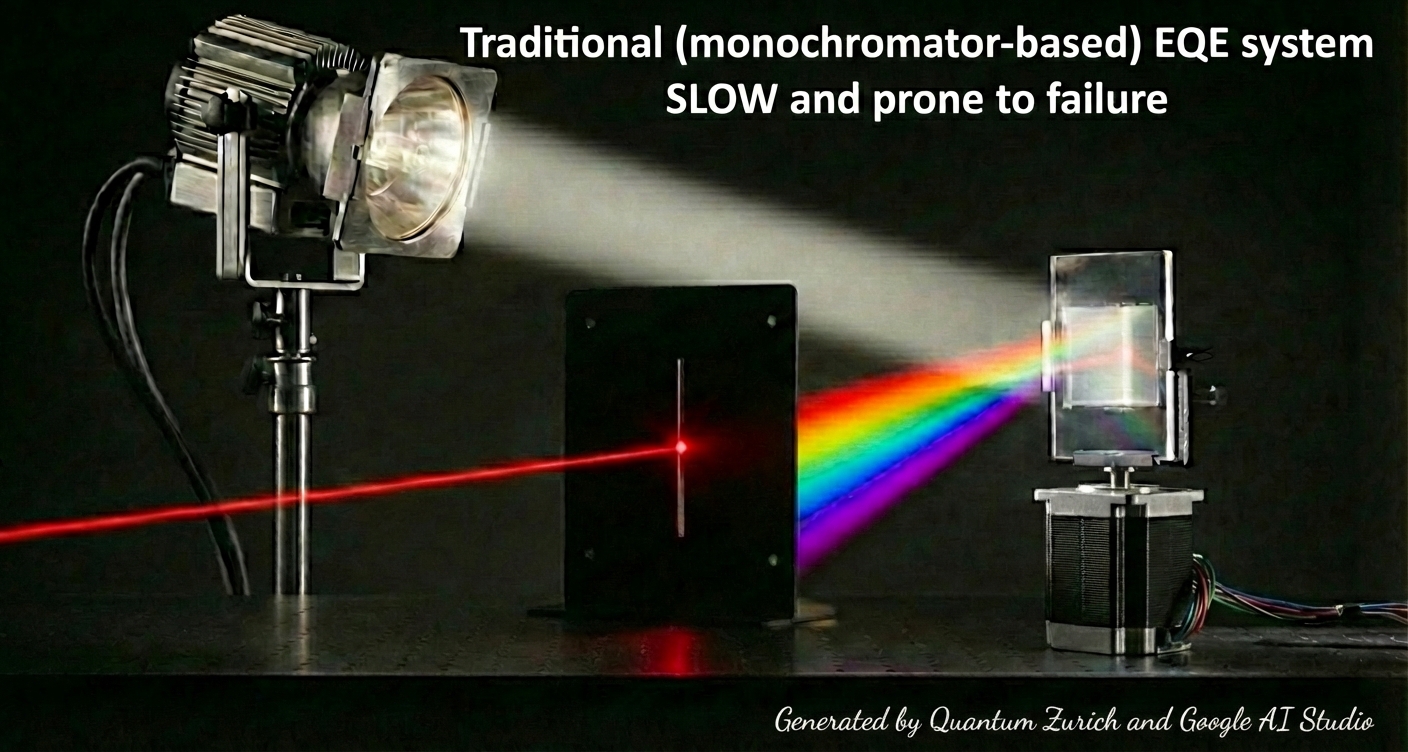
The Fast EQE system does not need the use of a monochromator. The system has no mobile parts, and so, has no monochromator. It doesn't need it. Our unique technology allows to measure, in parallel, all the wavelengths at once. This is the reason why the Fast EQE system is so fast (it takes only 3 seconds to measure the complete EQE curve). However, the traditional (monochromator-based) systems need a stepper motor to move a diffraction grating in order to sweep all the wavelengths, and this serial process is actually very slow, around 5 minutes, an prone to failure in the future.
The two key questions to compare the speed in both systems (the Fast EQE and the traditional one) are: how many points (wavelengths) does the EQE curve have?, and how long does it take to perform this measurement? The answer for the Fast EQE is: 46 wavelengths in only 3 seconds, so its speed is 15 wavelengths per second.
Furthermore, the Fast EQE system does not use a Xenon lamp, instead, it uses Light-Emitting Diodes (LEDs) as a light source. In terms of life span, LED lights boast a long service life of up to 50,000 hours, while Xenons offer around 2,000 hours of light. The energy consumption between the two also differs: LED bulbs use around 95% less power than Xenon bulbs.
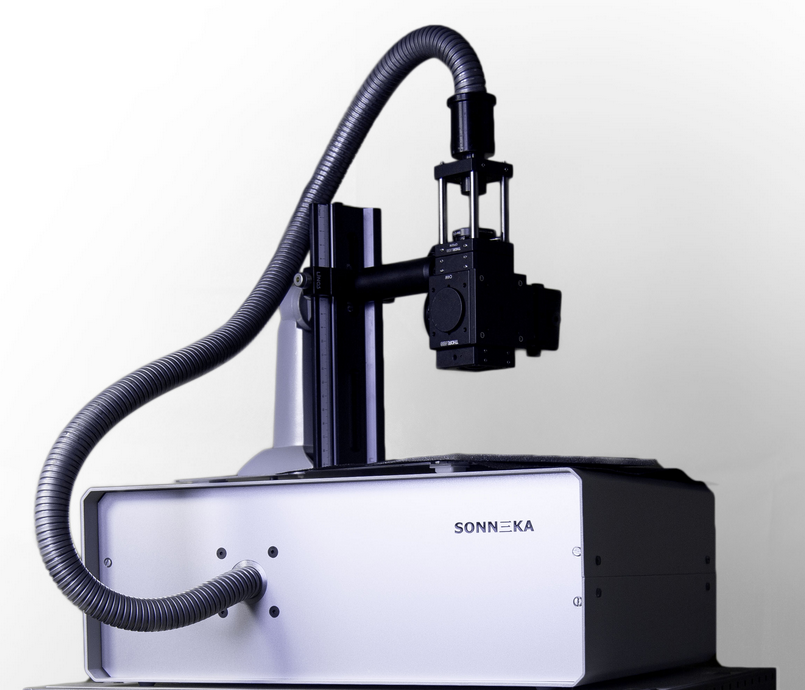
Place only this part of the Fast EQE system inside your glove box :

The FAST Quantum Efficiency measurement system (Fast EQE) provides high-speed operation. As a result, the system is capable of performing a single measurement in only 3 seconds, which has to be compared with the nearly 5 minutes necessary to perform the same measurement with a traditional (grating based) EQE measurement system. Furthermore, this result is independent of the wavelength range covered by the measurement.
The FAST Quantum Efficiency measurement system can be used as a useful tool to perform very fast analysis of the quantum efficiency of solar cells, as well as to evaluate the homogeneity and reproducibility of the fabrication process.
This is a system made to rocket up solar cell R & D projects. Quantum Efficiency measurements no longer cause bottlenecks, making fast analysis of solar cells possible for researchers for the first time.
Furthermore, the use of solid-state Light Emitting Diodes (LED) technology as a light source, instead of a Xenon Lamp, is well known for its excellent long lifetime (typically 50,000 h) and quiet operation. Additionally, it has lower energy consumption and it has no health hazards. The LED technology eliminates maintenance thanks to the absence of mobile parts (gratings) inside the system and the long lifetime of the LED-based light source.

The FAST Quantum Efficiency measurement system provides high-speed operation and excellent long-term stability. The high speed operation results from the parallel driving of a set of Light Emitting Diodes (LEDs) and the subsequent analysis of the signal by Fourier Transform techniques.
A series of 46 LEDs with a wavelength ranging from 310 nm to 1200 nm are simultaneously driven at different frequencies. The electrical signal induced by each photon at the solar cell is then amplified and analysed as a whole to extract the quantum efficiency by a FAST Fourier analysis.
| Specifications | |
|---|---|
| Measurement time (s) | 3 |
| Spectral range (nm) | 310 - 1200 |
| Spot size diameter (mm) | (1)2-4 |
| Beam splitter and light intensity monitor photodetector | Yes |
| Working distance (cm) | 5 |
| Number of wavelengths | 46 |
| Light source | LEDs |
| Bias light(to measure tandem cells) | RedBlue |
| Bias voltage (mV) | ±5000 |
| Probe connector | BNC |
| Dimensions (cm)WxHxD | Electronicbox:45x28x38Optical box: 37x14x30 |
| Weight (kg) | 40 |
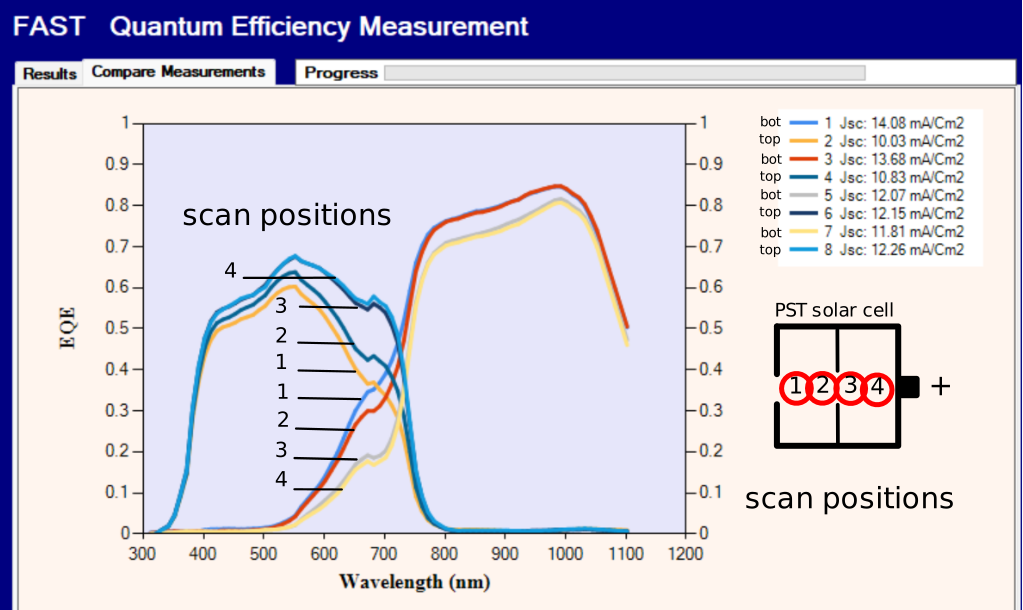
Click & Measure: the FAST Quantum Efficiency measurement system is commanded by a graphical user interface that allows the user to measure the quantum efficiency very FAST, in one simple CLICK. In the above figure, the EQE, in four different positions, of a Silicon-Perovskite tandem solar cell is shown. Measuring the 8 EQE curves took only 1 minute. These 8 measurements would take 40 minutes in a monochromator-based EQE system !!
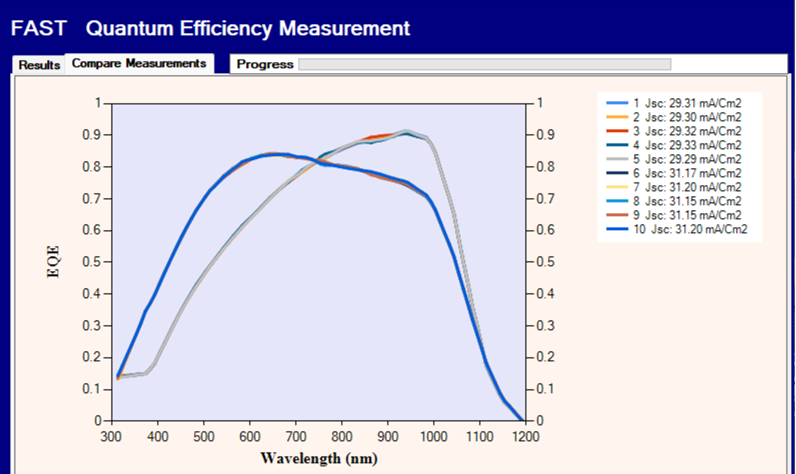
High repeatability: the above figure shows the result of five measurements of the quantum efficiency performed on two different c-Si solar cells. The excellent reproducibility of the system allows to appreciate small differences between the quantum efficiency of different devices.
Comparing data: the graphical user interface also allows the user to compare, in-situ and in a very simple and fast way, the quantum efficiency of multiple saved data.
The FAST Quantum Efficiency measurement system consists of the following parts: 1) the electronic system (bottom box), which is capable of driven individually each LED of the source light as well as the high power LEDs of the bias light, 2) the optical system (top box), which allows the LEDs light to be focused into an external optical fiber cable, and 3) the optical head, which is formed by a beam splitter and a photodetector to monitor the intensity of light that is captured by the solar cell.
The flexible optical fiber cable and the optical head (FLEX-HEAD) can be positioned in whatever orientation, in both horizontal and vertical configurations, to be easily adapted to customised measurement setups.
info@quantumzurich.com
Rue des Berthoudes 72 CH-2000 Neuchâtel Switzerland
Home
Product
Product video
Product advantages
Product details
Distributors
Contact and service
Privacy policy

 and
and